Mastering Nutrient Variety: Macros, Micros & Flavonoid Foods
Focusing on nutrients for added benefits can be a real challenge without a tool. Powered by measurement-based USDA data [1][3], Tip-Top Food™ provides deep nutrient exploration across 97 nutrients—so you can build meaningful nutrient variety using foods you genuinely enjoy.
Experience true nutrient variety through detailed food sources for macronutrients, vitamins, minerals, and advanced phytonutrients—supported by comprehensive USDA-backed data.
Within this section, you will take away a ten thousand foot view of the various nutrients and how to proactively include them in your day with sample 1-day mention for meal ideas and a couple of food breakdowns.
Why Nutrient Variety Matters for Real-World, Everyday Nutrition
Eating a diverse range of foods keeps meals enjoyable while helping you intentionally build meaningful nutrient variety. True nutrient variety goes beyond just eating lots of different foods [14] [15]. It is focused on different nutrients like macronutrients, micronutrients, and phytonutrients—working together as part of whole-food dietary patterns.
Simply put: increasing the types of nutrients you consume increases nutrient variety.
Start with daily essentials such as vitamins and minerals with established FDA Daily Values, along with healthy fats, quality protein, complex carbohydrates, and hydration. Then expand beyond the basics with researched nutrients like omega-3 fatty acids, carotenoids (tomatoes and leafy greens), and flavonoids (like berries, tea, and cocoa) that contribute to broader dietary variety. Many whole foods naturally contain multiple phytonutrients, making variety both practical and sustainable.
Rather than focusing on a single nutrient, combining foods with diverse nutrient profiles supports balanced intake through real-world meals.
Bioavailability: It’s Not Just What You Eat — It’s What Your Body Absorbs
Bioavailability refers to the proportion of nutrients your body absorbs and can use. Absorption may vary depending on food combinations, nutrient interactions, dietary patterns, and individual factors. For example, consuming dietary fats—such as monounsaturated fats or omega-3 fatty acids—alongside foods containing fat-soluble vitamins (A, D, E, and K) [13] may influence absorption as part of a mixed meal.
Tip-Top Food™ lets you explore nutrient-dense foods and dietary fats using USDA-sourced data, helping you make informed food choices that support nutrient intake and absorption within everyday meals. PRO TIP: For deeper strategies and examples, see Improving Flavonoid Bioavailability.
Expanding Nutrient Variety with Advanced Phytonutrients: Flavonoids & Carotenoids
Nutrient variety extends beyond vitamins and minerals. Many whole foods also contain phytonutrients, naturally occurring compounds found in plants that are commonly studied for their role in overall dietary quality and diversity. Examples of phytonutrients are flavonoids and carotenoids.
Flavonoid-Rich Whole Foods and Nutrient Variety
Flavonoids are a large and diverse group of phytonutrients found in fruits, vegetables, legumes, tea, and cocoa. While they have been studied for decades, they are often underrepresented in mainstream nutrition guidance compared to macronutrients and essential vitamins. Population-based research [6], has examined dietary patterns rich in flavonoid-containing foods, while targeted studies on foods such as cocoa [9] continue to explore their functional characteristics within whole-food diets.
Tip-Top Food™ helps you identify flavonoid-rich foods using USDA-measured nutrient data per serving, making it easier to explore and intentionally diversify your food choices.
Carotenoids for Expanded Nutrient Variety
Carotenoids are another major phytonutrient group found in colorful fruits and vegetables. These compounds contribute to dietary diversity and are commonly included in discussions of whole-food nutrition.
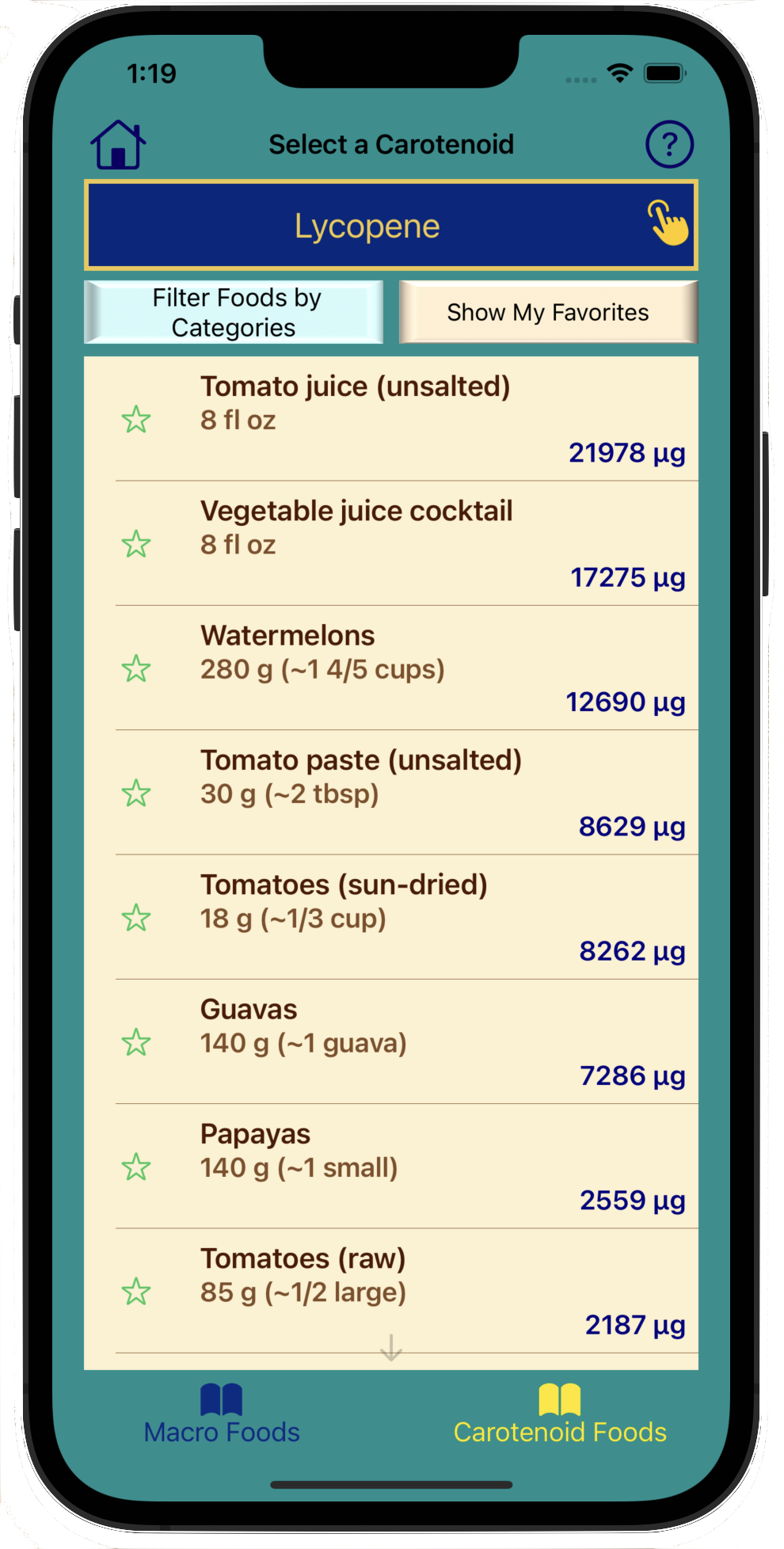
Tip-Top Food™ provides USDA-backed data for five key carotenoids per food, allowing you to explore and compare foods that contribute to broader phytonutrient variety.
- Alpha-carotene
- Beta-carotene
- Beta-cryptoxanthin
- Lycopene
- Lutein and zeaxanthin
To get the highest density go to the ranked nutrient specific listings. If you mark a favorite food on the ranked list, the food will be moved to the top for positive reinforcement! You’ll see immediately a food that you want to eat.
Top Carotenoid Foods
Ranked by USDA Data
Exploring Flavonoid Variety with Real Foods & USDA Data
Improving Flavonoid Bioavailability
Flavonoid Diversity Strengthens Nutrient Variety
U.S. guidelines [4] recommend eating a variety of phytonutrient-rich fruits and vegetables. These foods contain different flavonoids and carotenoids, supporting broader nutrient variety.
Science categorizes flavonoids into six subgroups [10] , and Tip-Top Food™ includes six selectors to encourage diversity within each group. The serving size align with standards from the United States Food and Drug Administration [16] which were established to reflect portions that people actually eat (adjustable for personal goals). All nutrient data comes from the United States Department of Agriculture [3] to support consistent data. Within each subgroup, you can explore foods with specific flavonoids like Quercetin.
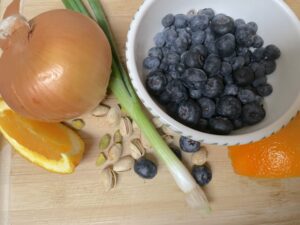
The table below highlights foods from different flavonoid subgroups to illustrate how variety strengthens overall phytonutrient coverage.
| Photo | Food Source | Flavonoid Subtype | Key Compounds |
|---|---|---|---|
![]() |
Blueberries | Anthocyanins, Proanthocyandins, Flavan-3-ols, & Flavonols | Cyanidin, Catechin, Delphinidin, Malvidin, Proanthocyanidin trimers & Quercetin |
![]() |
Onions | Flavonols | Isohamnetin & Quercetin |
![]() |
Oranges | Flavanones | Hesperetin & Naringenin |
![]() |
Pistachios | Flavan-3-ols & Isoflavones | Catechin, Epigallocatechin, Genistein & Daidzein |
Flavonoid absorption varies depending on how foods are combined, prepared, and structured. Three real-food factors that can influence how your body uses plant compounds include:
1. Fat-Containing Foods & Plant Compounds
Some flavonoids may be more easily used by the body when eaten as part of a meal that includes fats. Fats help create a digestive environment that supports how certain plant compounds are processed during digestion [8][12].
Example: Sautéed onions cooked with egg yolks or olive oil
2. Fatty Acid Synergy
Meals that include omega-3 fatty acids (DHA/EPA) alongside plant foods bring together nutrients that support complementary biological processes in the body [7].
Example: Salmon with a side of steamed broccoli
3. Bioavailability & Preparation Methods
The physical structure of plant foods and how they are prepared can influence how flavonoids are released during digestion. Fiber structure, chopping, and cooking methods all affect accessibility of plant compounds [11].
Example: Green peas with green tea
Flavonoid Food Profiles and a Proactive 1-Day Sample Menu to Expand Your Nutrient Variety
Experience the synergy of full nutrients. We include a one-day menu which intentionally pairs flavonoid-rich foods with fat-containing foods to support nutrient absorption, as discussed in the Improving Bioavailability section. Individual high flavonoid content foods like oranges and blueberries can be added to a meal for extra flavonoids.
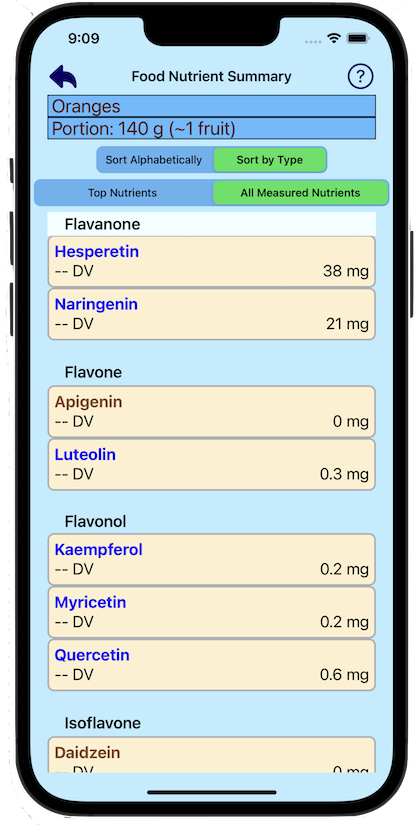
🍊 Tip-Top Food Oranges
Flavonoid Profile (USDA Data)
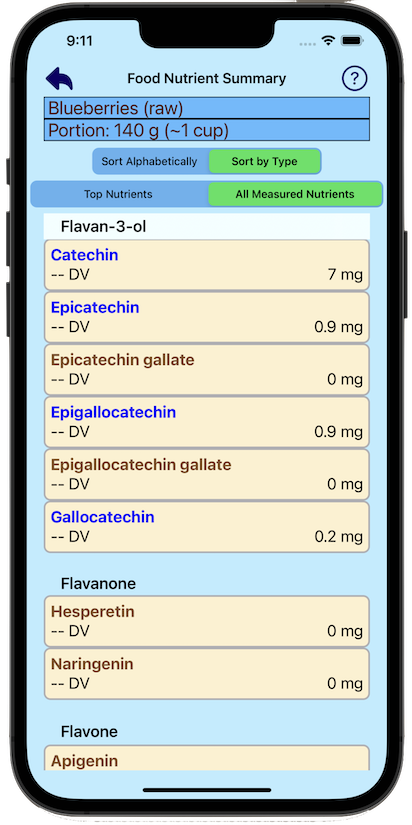
🫐 Tip-Top Food Blueberries
Flavonoid Profile (USDA Data)
One-Day Menu: A Practical Way to Enjoy Flavonoid Variety
A practical way to strengthen nutrient variety throughout the day.
2 Eggs (any style), 1/4 cup Blueberries**, and 1/2 fresh Orange**.
Romaine, red cabbage**, carrots, green onions**, red onion**, blackberries**, green pepper**, almonds**, sesame seeds, lightly seared tofu**, with sesame-ginger dressing using olive and sesame oil.
A handful of Pistachios** with 1 1/2 cups of Green Tea**.
Baked Salmon with steamed Asparagus** and a garnish of fresh Parsley**.
Note: No official intake recommendations exist. Intake totals are estimates based on the USDA flavonoid databases.
Want to explore how these menu foods connect to underlying research and nutrient data?
- To understand the underlying research sources, refer to
USDA Flavonoid Databases Information. - To explore how to experience proactive features visit Proactive Nutrition Features.
- To add flavonoids to the Tip-Top Food base, refer to Unlock Deeper Nutritional Insights.
Unlock Deeper Nutritional Insights
Upgrade to the Tip-Top Food™ Flavonoid Master List. Specifically, you get lifetime access to comprehensive data with 6 different flavonoid subgroups for a total of 30 individual flavonoids sourced from three official USDA databases.
Download Tip-Top Food™
Then tap any locked nutrient button
Instantly unlock ALL 30 for $0.99
Evidence-based nutrition exploration. One-time purchase. No subscriptions.

FAQs: Mastering Nutrient Variety
FAQs: Accessing Nutrient Variety with Scientific Precision
FAQs: Flavonoid Information
Scientific References: Nutrient Variety & Flavonoids
Peer-reviewed research and USDA data forming the scientific foundation for Tip-Top Food™ flavonoid and variety measurements.
USDA Nutrient Databases & FDA Measurement Guidance
+
- [1] USDA Databases for Standard Nutrients: SR28; Iodine Release 3; FNDDS 2013–2014. [Back to Intro]
- [3] USDA Flavonoid Composition Databases (Flavonoids, Isoflavones, Proanthocyanidins).
Tip-Top Food™ integrates multiple USDA phytochemical databases.[Back to Intro] | [Back to Table] | [Back to Nutrient FAQ] | [Back to Measure FAQ] | [Back to Fruit FAQ]
- [16] United States Food and Drug Administration. Reference Amounts Customarily Consumed: List of Products for Each Product Category: Guidance for Industry. [Back to Diversity]
Population Studies
+
- [2] Sebastian, R. S., et al. (2022). Flavonoid Intake in the U.S. NHANES 2017-2018. [Back to FAQ]
- [6] Murphy, K. J., et al. (2019). Adult Dietary Flavonoid Intake and Health Outcomes: An Umbrella Review. [Back to Variety] | [Back to FAQ]
- [9] COSMOS Trial (2025). Cocoa Supplement and Multivitamin Outcomes Study. [Back to Variety]
Bioavailability & Mechanisms
+
- [12] Bohn, T. (2014). Dietary factors affecting polyphenol bioavailability. Nutrients. [Back to Bio] | ↩ [FAQ]
- [11] Rodriguez-Mateos, A., et al. (2014). Bioavailability and health impact of dietary flavonoids. [Back to Bio] | [Back to FAQ]
- [14] Foote, J. A., et al. (2004). Dietary variety and nutrient adequacy. J. Nutrition. [Back to Variety] | [Back to FAQ]
- [15] Drewnowski, A. (2005). Concept of a nutritious food: nutrient density score. AJCN. [Back to Variety] | [Backto FAQ]
Phytonutrient Education & Guidelines
+
- [7] Bansal, S., et al. (2013). Synergy of flavonoids and Omega-3 fatty acids. J. Clin. Med. [Back to Bio]
- [8] Guo, Y., et al. (2019). Fat-soluble vitamins and polyphenols: Synergy in absorption. Nutrients. [Back to Bio]
- [13] Dawson-Hughes, B., et al. (2015). Dietary fat increases vitamin D-3 absorption. JAND. [Back to Bio]
- [4] U.S. Dietary Guidelines for Americans. Nutritional Goals. [Back to Diversity]
Food Pairing & Nutrient Interactions
+
- [10] Linus Pauling Institute. Flavonoids. Micronutrient Info Center. [Back to Diversity]
- [5] Peterson, J. J., et al. (2006). Flavanones in oranges and tangerines. J. Food Comp. Anal. [Back to FAQ]